
What is the Best Type of Swimming Pool for My Home? FOR REVIEW
If you’ve started researching pools, you’ve probably noticed that every website seems to have a different opinion about which type is “best.” That’s because there isn’t one universal answer. The best type of swimming pool for your neighbor’s budget and backyard might be the wrong call for yours. What matters is how the four main pool types compare on the things that affect your day-to-day ownership: upfront cost, how long installation disrupts your yard, how much upkeep you’re signing up for and how long the pool is going to last.
Leisure Pools is one of the world’s largest manufacturers of inground fiberglass pools, so you might expect us to just tell you fiberglass wins every time. Instead, here’s an honest look at all four options, including where fiberglass isn’t the right fit, so you can make the call that’s right for your home.
- It’s a tradeoff, not a ranking: Above ground, vinyl liner, concrete and fiberglass each win on different priorities: cost, customization, installation speed or long-term maintenance.
- Above ground pools cost the least upfront: but typically last 8 to 15 years structurally and can be a drawback rather than a boost when it’s time to sell.
- Vinyl liner pools save $5,000 to $10,000 at installation: but the liner usually needs replacing every 7 to 12 years at $3,000 to $7,000 a pop.
- Concrete offers the most design freedom of any pool type: at the cost of roughly 3 months of construction and resurfacing every 8 to 15 years.
- Fiberglass installs in as little as 5 days: and needs the least ongoing maintenance of the four, with a tradeoff of a fixed range of shapes and a maximum size of 40 feet by 16 feet.
How the four pool types compare
| Above ground | Vinyl liner | Concrete (gunite) | Fiberglass | |
| Upfront cost | Lowest of all four options | $5,000-$10,000 less than concrete or fiberglass | Comparable to fiberglass; rises with customization | Comparable to concrete |
| Installation time | A few days | Several weeks | Around 3 months | As little as 5 days |
| Typical lifespan | 8-15 years structurally | Liner needs replacement every 7-12 years | 8-15 years before resurfacing | Backed by a lifetime structural warranty |
| Maintenance | Moderate; prone to rust and wear | Moderate; liner tears and punctures | Highest; regular acid washing and algae control | Lowest; smooth, non-porous surface |
| Design freedom | Circle, oval or rectangle only | Nearly unlimited shapes and depths | Unlimited; fully custom | Wide range of pre-engineered designs up to 40′ x 16′ |
| Resale impact | Often a neutral or negative factor | Rarely adds significant value | Generally, adds home value | Generally, adds home value |
Above ground pools: the budget option
The advantage is straightforward: cost. An above-ground pool is less expensive than any in-ground option, if you’re not building an elaborate deck around it (at which point you’ve spent close to what an in-ground pool would have cost anyway).
The tradeoffs show up over time. Most homeowners find above-ground pools limiting in looks, since many subdivisions restrict them entirely through HOA covenants, and even a well-built deck rarely makes one feel like a permanent part of the home. They’re also boxed into a handful of shapes, typically circle, oval, or rectangle, and the metal walls are prone to rust and wear, with most structures needing replacement in the 8- to 15-year range. That combination often makes an above-ground pool a neutral or even negative factor when it’s time to sell.
Vinyl liner pools: low cost, more upkeep down the road
The advantage is the price tag paired with design flexibility. Vinyl liner pools typically cost $5,000 to $10,000 less upfront than concrete or fiberglass, and the liner itself can be shaped into nearly any size, depth or curve you want.
The tradeoff is the liner. It’s a polymer material that breaks down over time and can tear or pull away from the pool walls. Most liners last 7 to 12 years before needing replacement, at a cost of $3,000 to $7,000 depending on the pool’s size and shape. Many owners also find that a vinyl liner installation looks noticeably less finished than a concrete or fiberglass pool, which is part of why liner pools typically add less resale value. It’s worth noting that in several other countries, vinyl liner pools have largely been phased out in favor of concrete and fiberglass.
Concrete (gunite) pools: unmatched customization, high maintenance
The advantage is design freedom. Concrete can be poured into essentially any size, shape or depth, which makes it the pool type of choice for anyone with a very specific vision or an unusual site. It also tends to add solid value to a home at resale.
The tradeoff is everything that comes after the pour. Concrete’s rougher, porous surface needs more chemicals and regular brushing to stay algae-free, plus a resurfacing job roughly every 8 to 15 years. That same surface can be tough on kids’ bare feet after a few hours of play. Construction also takes time, typically around 3 months of your yard being an active job site, and concrete pools don’t pair as well with salt chlorination, often requiring more maintenance and earlier resurfacing than pools built for salt systems from the start.
Fiberglass pools: fast installation, low upkeep
The advantage is how little the pool asks of you once it’s in the ground. The smooth, non-porous shell resists algae, and paired with a salt chlorinator, many owners describe the maintenance as close to hands-off. Because the shell is manufactured off-site and simply lowered into an excavated hole, installation can wrap in as little as 5 days, with decking and landscaping to follow. Leisure Pools shells also come with a Lifetime Structural Warranty and Lifetime Osmosis Warranty (see warranty for full terms; lifetime means no less than 35 years), well beyond what above ground, vinyl or concrete pools typically offer. And because the shell is molded off-site, what you see in the design rendering is exactly what ends up in your backyard, no surprises the way an on-site concrete pour sometimes delivers.
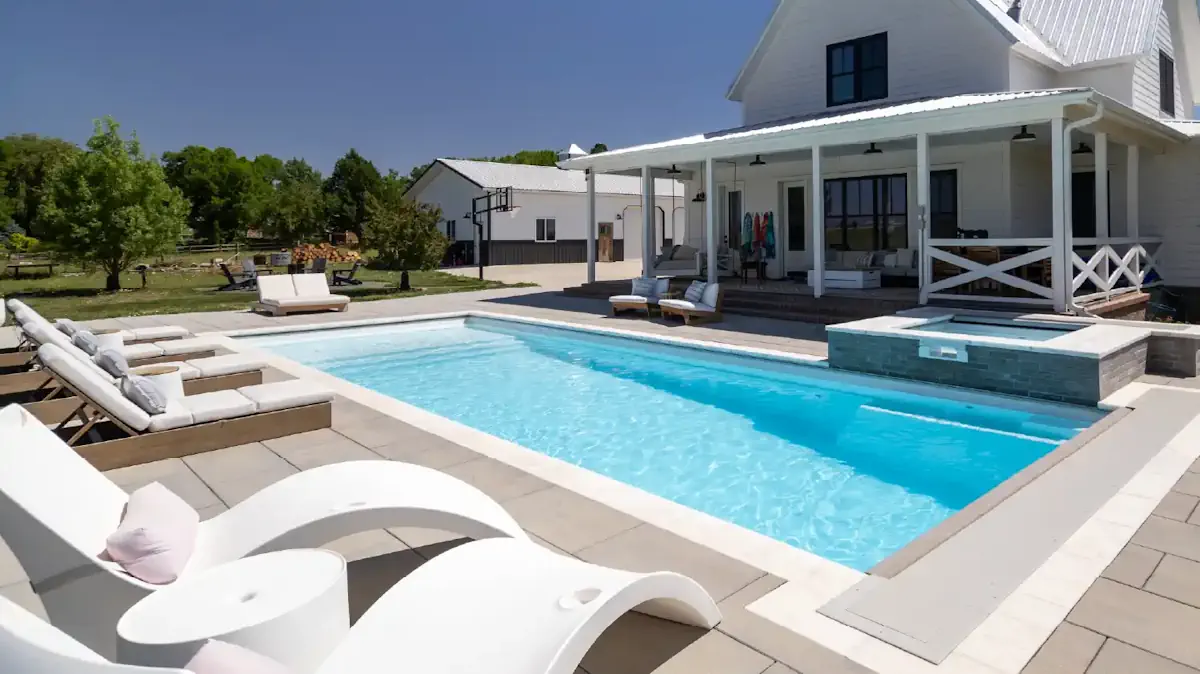
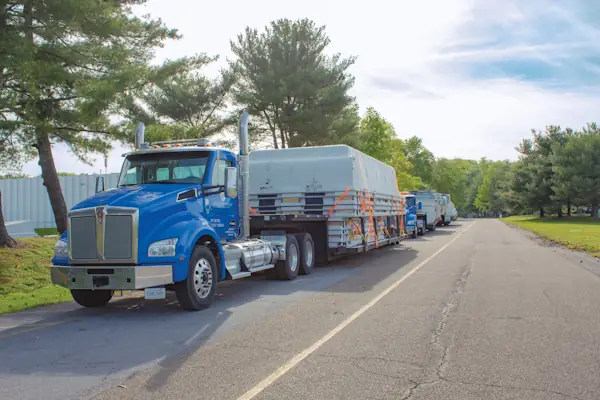
The tradeoff is size and shape flexibility. A fiberglass shell must be trucked to your home, which caps our largest design at 40 feet long and 16 feet wide (in practice, that covers about 95% of pool projects). And because each design comes from an engineered mold, you’re choosing from our existing range rather than a fully custom shape. If you need something larger than 40 feet or a design outside what’s available, concrete is the better fit.
Which pool type fits your situation?
If your top priority is the lowest possible price today: An above ground pool wins on cost, though it’s worth weighing that against the shorter lifespan and limited resale impact.
If you want an inground pool but need to stay on a tight budget: Vinyl liner gets you there for less upfront, as long as you’re comfortable budgeting for a liner replacement down the road.
If you have a very specific shape or size in mind, or a challenging site: Concrete is built for that kind of customization, and it’s the only option with no real size ceiling.
If low maintenance and fast installation matter most: Fiberglass is designed around exactly those two priorities, and it’s why we build what we build. Curious what that looks like for your yard? Our model finder lets you browse shapes and sizes, and our fiberglass pool cost guide breaks down what a project typically runs.
Frequently asked questions
The bottom line on the best pool type
There’s no single “best” pool type, only the best type for your budget, timeline and how much upkeep you’re willing to take on. For most homeowners weighing all four factors together, fiberglass tends to offer the strongest overall balance, especially when maintenance and installation speed matter. But if your yard calls for a fully custom shape or a size beyond 40 feet, concrete deserves a serious look.
Ready to see what fits your home? Connect with your nearest Leisure Pools dealer to talk through your options or explore our full range of pool designs to start browsing.


Share This Story, Choose Your Platform!
In This Article:
- How the four pool types compare
- Above ground pools: the budget option
- Vinyl liner pools: low cost, more upkeep down the road
- Concrete (gunite) pools: unmatched customization, high maintenance
- Fiberglass pools: fast installation, low upkeep
- Which pool type fits your situation?
- Frequently asked questions
- The bottom line on the best pool type
- Written by Ann Butenas.
- Locate a dealer and start your pool project today.
 United States
 Canada
 Australia
 New Zealand
 Europe
 Find a Dealer
 (855) 857 7527
 Leisure Pools USA